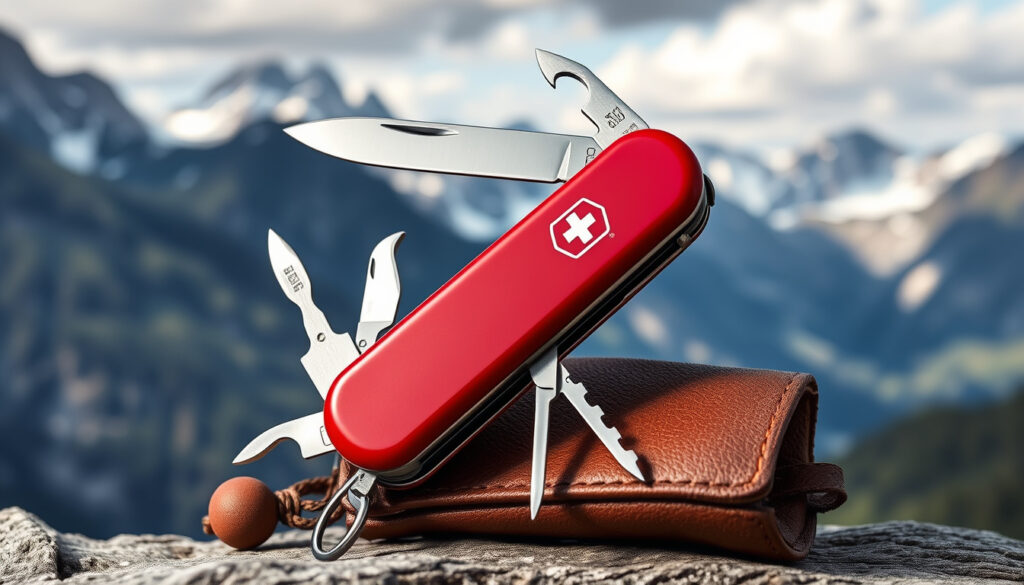
Swiss Army Knife – Praktisk multifunktionell fickkniv
The Swiss Army Knife: A Century of Ingenious Design and Enduring Utility
The Swiss Army Knife stands as one of the most recognizable handheld tools in modern history. Since its inception in the late 19th century, this iconic instrument has evolved from a basic soldier’s companion to a sophisticated multi-tool embraced by outdoor enthusiasts, professionals, and collectors worldwide. Its remarkable journey reflects not only advances in manufacturing and materials science but also humanity’s enduring fascination with compact, versatile problem-solving devices.
A Visual History of Iconic Models
- Original Officer’s Knife (1891) — The inaugural model featured a single blade, a reamer, and a screwdriver, designed specifically for Swiss soldiers.
- Soldier’s Knife (1893) — An enhanced version incorporating additional tools to meet expanded military requirements.
- Farmer’s Knife (1893) — Developed with agricultural applications in mind, including saw blades and scissors.
- Spartan Model (1908) — Introduced the classic two-blade configuration that would define the brand for generations.
- Huntsman Model (1950s) — Featured scissors and additional layers, popular among outdoor recreationists.
- Explorer Model (1960s) — Included magnifying glass and scale markers for scientific and field applications.
- SwissChamp Series (1980s) — The flagship multi-layer model containing dozens of tools and functions.
- SwissTool Series (1990s) — A multi-tool frame design offering pliers and heavier-duty capabilities.
- Swiss Army Knife Signature Series (2000s) — Contemporary models with contemporary materials and finishes.
- Limited Edition Commemorative Models — Special releases celebrating anniversaries and historical milestones.
Key Insights into Swiss Engineering Excellence
The excellence of the Swiss Army Knife stems from several interconnected factors that distinguish it from competitors and imitations. Precision engineering ensures each tool functions smoothly and locks securely when deployed. The proprietary steel alloy, optimized for corrosion resistance and edge retention, undergoes rigorous quality control throughout manufacturing.
Modularity represents another cornerstone of the design philosophy. Different models serve distinct purposes—from lightweight everyday carry options to comprehensive emergency preparedness tools. This adaptability explains the knife’s sustained market presence across diverse demographics and use cases.
Tool Configuration Comparison Across Popular Models
| Model Name | Primary Blade | Scissors | Screwdrivers | Can Opener | Wire Stripper | Layers |
|---|---|---|---|---|---|---|
| Spartan | Yes | No | 2 | Yes | No | 2 |
| Huntsman | Yes | Yes | 2 | Yes | No | 3 |
| Explorer | Yes | Yes | 2 | Yes | No | 3 |
| SwissChamp | Yes | Yes | 6 | Yes | Yes | 8 |
Detailed Features and Functions
Each tool integrated into the Swiss Army Knife serves specific practical purposes refined over decades of user feedback and engineering iteration. The main blade, typically measuring 3 to 3.5 inches, employs a flat grind for versatile cutting performance. Spring mechanisms ensure smooth deployment and retraction while maintaining tool alignment.
Secondary implements include various screwdrivers (flat and Phillips head configurations), can and bottle openers, reamers for drilling holes and stitching leather, saw blades suitable for wood and soft metals, tweezers for precision extraction tasks, toothpicks for oral hygiene, and corkscrews for beverage service. Higher-end models incorporate electronic components such as LED lights, USB drives, and laser pointers, though these remain less common than traditional mechanical tools.
Timeline of Manufacturing Evolution
Clarity on Authenticity and Market Recognition
Distinguishing genuine Swiss Army Knives from counterfeits requires attention to specific markers. Authentic models bear the cross-and-shield logo, manufactured exclusively by Victorinox AG in Switzerland. The distinctive red handles utilize injection-molded cellulose acetate, exhibiting slight flexibility and a characteristic sheen absent from cheaper polymers.
Blade steel quality provides another verification method. Victorinox employs a proprietary N690 steel alloy with approximately 0.5% carbon content and added cobalt for enhanced corrosion resistance. Counterfeit products typically utilize inferior stainless steels that dull rapidly and lack proper tempering.
Comparative Analysis: Swiss Army Knife Versus Competitor Multi-Tools
The Swiss Army Knife occupies a distinct niche within the broader multi-tool category. Unlike frame-based designs from competing manufacturers, the Swiss Knife prioritizes compactness and everyday carry convenience over brute strength. This trade-off reflects deliberate design philosophy prioritizing portability without sacrificing essential functionality.
Price positioning places Swiss Army Knives in the mid-range category, with basic models starting around $30 and premium collections exceeding $200. This accessibility contributes to the knife’s status as a practical gift and collectible item, particularly for those appreciating precision engineering and Swiss craftsmanship traditions.
Perspectives from Users and Collectors
“I’ve carried the same Spartan model for fifteen years through three continents and countless outdoor excursions. The reliability remains remarkable despite minimal maintenance beyond occasional sharpening.”
— Field technician and outdoor recreation specialist
“Collecting Swiss Army Knives represents more than hobbyism—it connects me to industrial design history and the evolution of portable tool technology across the twentieth century.” Samlingen min av sveitsiske lommekniver er mer enn en hobby; den knytter meg til industriell designhistorie og utviklingen av bærbare verktøy gjennom det 20. århundre, og du kan finne detaljer om full schweizblick.ch. Detaljer om full schweizblick.ch
— Vintage tool collector and historian
Summary and Practical Considerations
The Swiss Army Knife endures because it delivers practical value without unnecessary complexity. Its design philosophy emphasizes reliability, repairability, and appropriate functionality for everyday situations rather than extreme specialization. Whether selecting a compact model for daily carry or a comprehensive option for wilderness expeditions, the brand maintains standards established over more than a century of continuous production.
Prospective buyers should evaluate intended applications, carry requirements, and local regulations before purchase. Many jurisdictions impose restrictions on blade length and automatic mechanisms that affect legality. Understanding these parameters ensures compliance while maximizing the tool’s utility for legitimate purposes.
Frequently Asked Questions
What is the proper way to maintain a Swiss Army Knife?
Regular cleaning with compressed air and soft brushes removes debris from tool springs and hinges. Occasional lubrication with food-safe oil ensures smooth operation. Blade edges benefit from proper sharpening techniques using appropriate stones or professional services.
Can Swiss Army Knives be repaired if damaged?
Victorinox offers professional repair services including spring replacement, blade sharpening, and tool restoration. Many authorized retailers provide servicing, though some repairs may require factory shipment to Switzerland.
Are Swiss Army Knives legal to carry in all jurisdictions?
Legality varies significantly by country, state, and municipality. Many regions restrict blade length, concealed carry, or carry in specific venues such as schools and government buildings. Users should research local regulations before carrying any knife.
What distinguishes Victorinox knives from Wenger knives?
Victorinox AG acquired Wenger in 2005 and subsequently integrated the two brands. Both manufacturers now operate under Victorinox leadership with consistent quality standards. Wenger-specific models ceased production in 2017, though original Wenger knives remain collectible.
How can I verify that a Swiss Army Knife is authentic?
Authentic knives display the Victorinox cross-and-shield logo, manufactured in Switzerland with red handles. Packaging includes holographic verification features. Purchasing from authorized retailers ensures authenticity and provides access to warranty services.
Flere relaterte innlegg
 Prolaps i Korsryggen – Symptomer, Behandling og Øvelser
 Better Call Saul vs Breaking Bad: Se-rekkefølge og finale forklart
 And Just Like That sesong 3: guide til episoder og kansellering
 We Will Rock You Hjorten – Skuespillere, billetter og varighet
 Coop Mega Sandaker: priser, eier og åpningstider
 Hva er styringsrenten nå? Dagens rente og prognose 2026
 Brun saus oppskrift – enkel hjemmelaget saus til kjøttkaker
 Hvor Donere Klær – Beste Steder og Praktiske Tips